Pre-feasibility report.
A concept-stage planning document combining memory, peace education, tourism and humanitarian housing into a single national recovery platform. Final site selection requires security clearance, explosive ordnance survey, structural and environmental assessment, community consultation, and government approval.
Two-track national recovery model.
Track A — Memory & Peace: preserve the most heavily damaged areas as carefully secured museum zones, interpretation routes and documentary centres.
Track B — Housing & Recovery: build rapid prefab housing, low-cost communities and later sustainable cities in safer areas with better access, climate suitability and government-supported land availability. Museum zones must not delay emergency shelter.
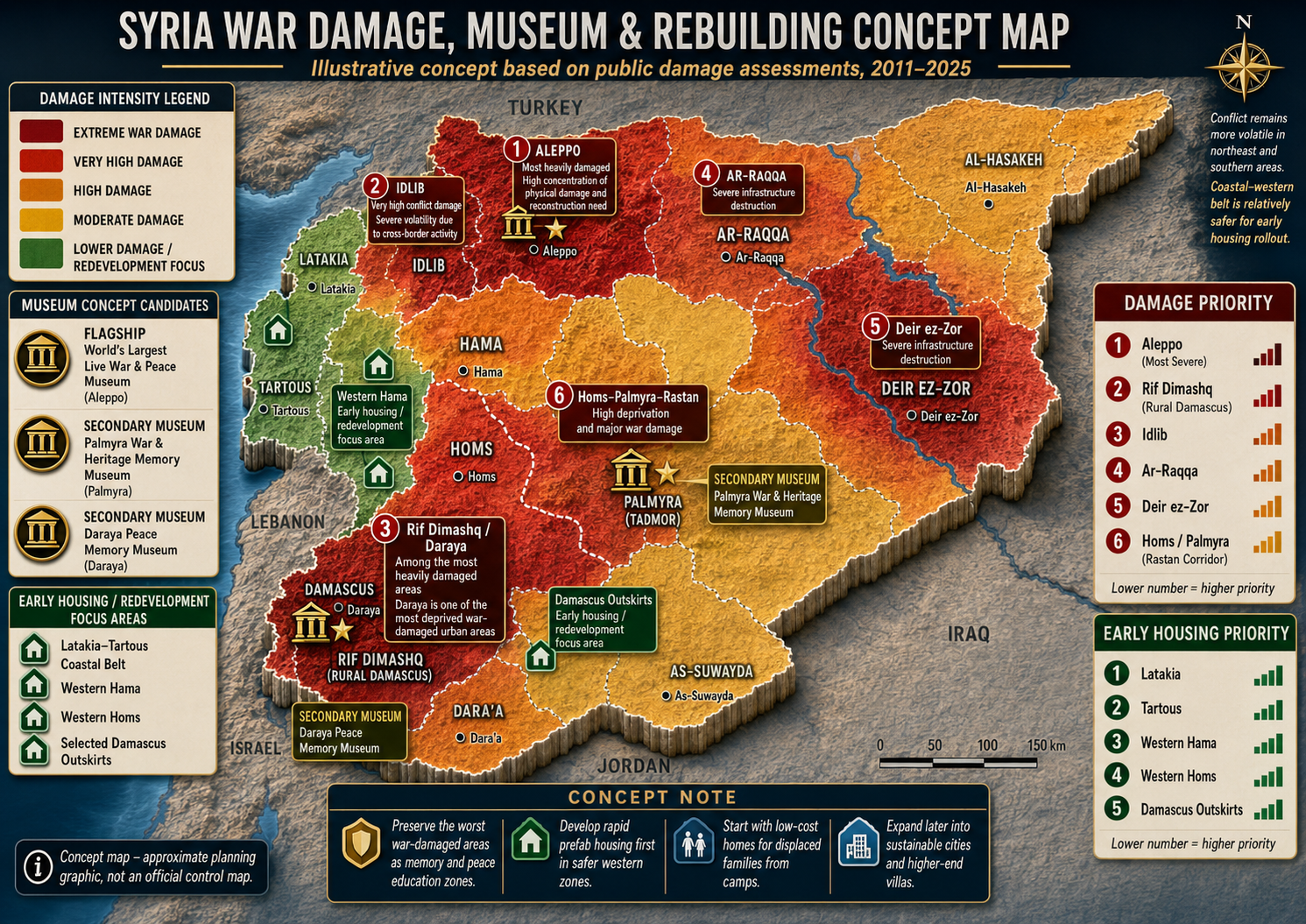
Damage intensity, museum candidates and early-housing zones.
Illustrative planning graphic based on public damage assessments (2011–2025). Click a node to read its role in the concept and jump to the relevant report section.
Filter the damage map. Read recovery insights.
World Bank rapid-assessment totals (US$ billions). Filter by region, set a minimum damage threshold, and click any governorate to surface its recovery insight and indicative horizon. National total: $108.1B assessed direct damage · ~$216B reconstruction estimate.
Seven project components.
Each site is composed of a consistent kit of parts, scaled to context and sequenced behind safety certification.
Secured Memory Zone
Fenced, monitored and structurally surveyed area preserving selected ruins and streets.
Peace Education Center
Classrooms, documentary theatre, digital archive, youth programmes and international peace seminars.
Survivor Story Archive
Audio/video testimonies collected only with informed consent and cultural sensitivity.
Viewing Routes
Safe elevated walkways, guided bus routes, viewing decks and clearly marked no-entry red zones.
Rebuilding Lab
Live demonstration of prefab housing, rubble recycling, solar microgrids and water systems.
Local Market
Shops for affected families, crafts, books, food, local products and heritage items.
Digital Museum
Online 3D scans, virtual tours and multilingual education for visitors who cannot travel.
From verification to sustainable cities.
The first 90 days focus on verification, not construction. The next decade builds the national network and links museum revenue into permanent reconstruction districts.
What could go wrong — and how we mitigate.
Every risk is paired with a specific mitigation. Safety, dignity and community consent are non-negotiable preconditions to any public access.