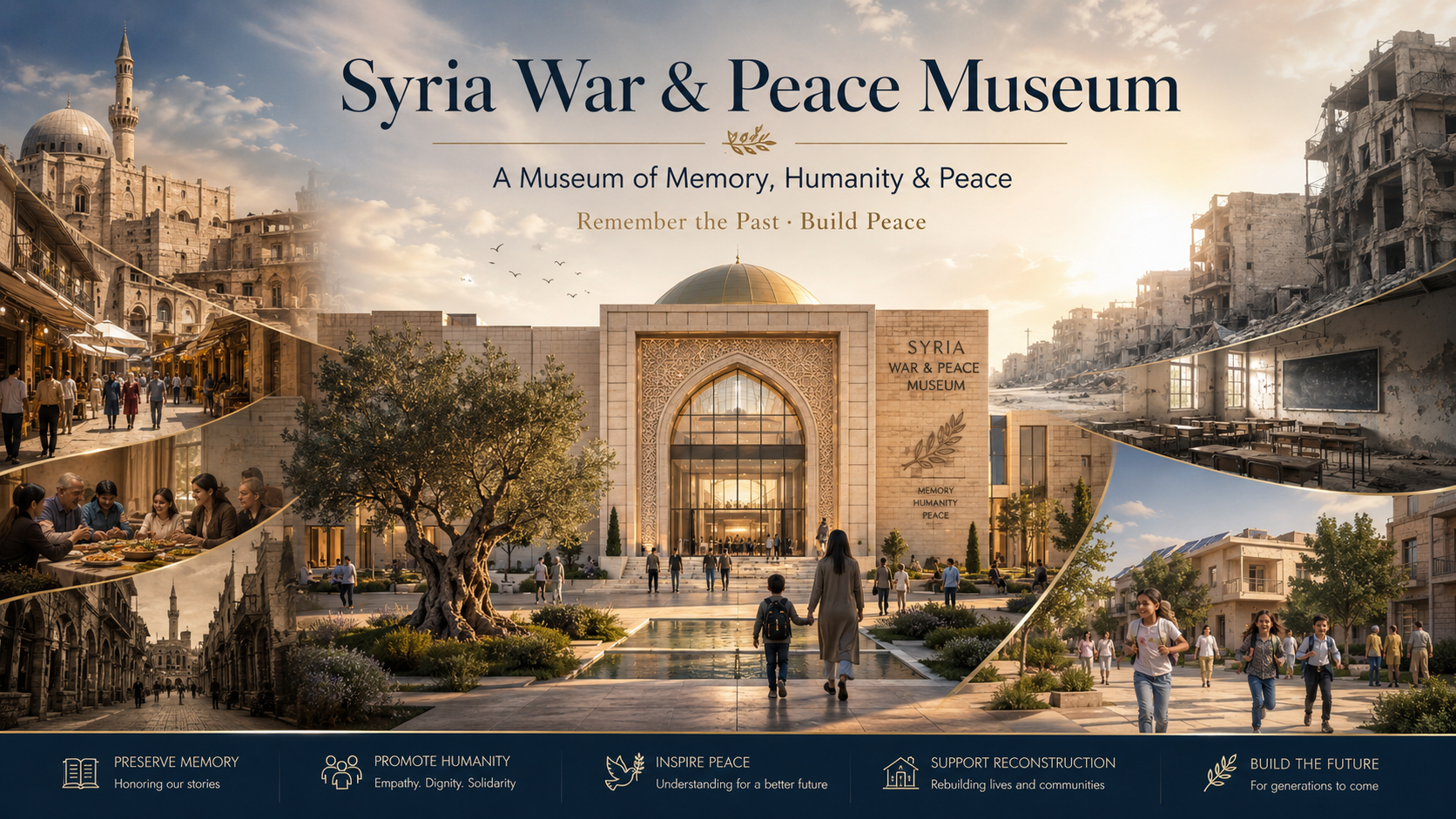
Concept view of the Syria War & Peace Museum with a civic courtyard and visitors approaching the entrance
Pillar one · Museum vision

A sanctuary for truth.

Memory, humanity & peace

A humanitarian museum to preserve Syrian memory, honour people, educate future generations, and promote peace and recovery.

No politics.

No hatred.

No glorification of war.

Only memory, humanity, education, peace, and rebuilding.

Why this museum

Why this museum now.

War destroys homes, schools, hospitals, families, culture, and hope.

This museum protects memory while teaching the value of peace and non-recurrence.

It connects remembrance to civic rebuilding rather than leaving loss without a public institution.

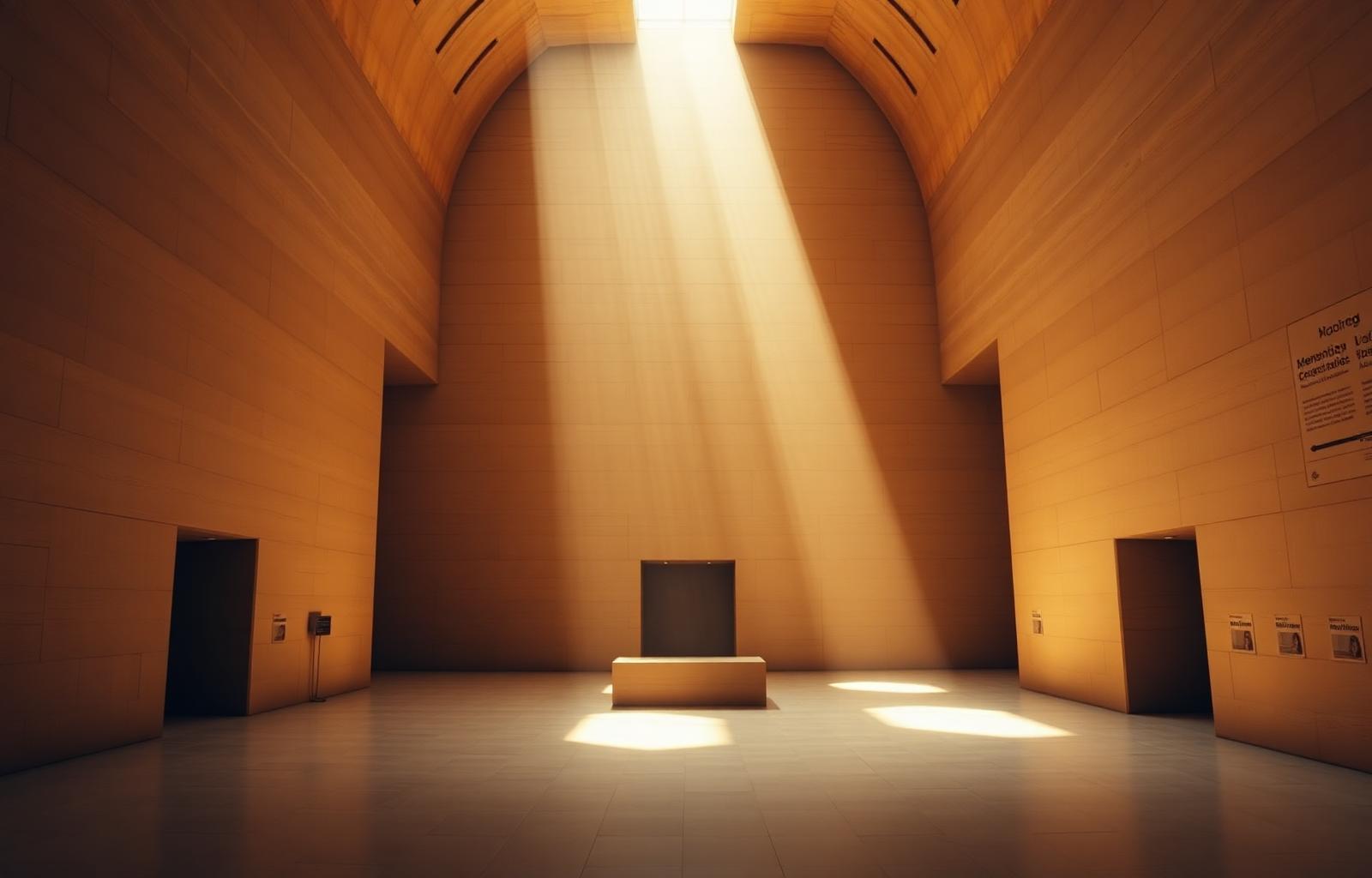
Interior memorial gallery for a museum of remembrance and peace
Defining “live”

Immersive, evidence-based, and witness-centered.

“Live” means continuously updated, ethically curated, and emotionally careful — never theatrical or militarized. The museum combines preserved artefacts, oral histories, digital archives, curated timelines, children's pathways, research spaces, and a peace gallery that looks forward as well as back.

The benchmark is serious international memorial practice: evidence before spectacle, human dignity before political messaging, and peace education after witness.

Gallery program

Seven gallery functions.

The visitor journey moves from context, to testimony, to remembrance, and finally to peace and rebuilding.

01

Origins & chronology

A factual timeline of context, actors, and consequences — to prevent confusion and politicized simplification.

02

Human stories

Testimony, photographs, diaries, and personal objects — centering individual dignity.

03

Cities under war

Urban destruction, displacement, hospitals, schools, and homes — the geography of loss.

04

Memory & names

A quiet memorial space for reflection, names, and symbolic remembrance.

05

Education & dialogue

School visits, teacher kits, youth workshops, and moderated public dialogue.

06

Archive & research

Conservation labs, oral history collection, digital archive, and visiting scholars.

07

Peace & future

Recovery, coexistence, reconstruction, and youth aspiration — memory linked to rebuilding.
Accessibility & emotional safety

  • Universal design and physical accessibility on every route
  • Arabic, English, and French interpretation with sign and caption support
  • Low-stimulation routes, quiet rooms, and screened graphic content
  • Children's pathways with trauma-informed exhibition design
  • Content warnings and on-site psychological support protocols

Conservation & security

  • Collections storage with environmental controls
  • Chain-of-custody and provenance safeguards
  • Anti-trafficking protocols aligned with UNESCO standards
  • Digitisation with resilient off-site digital backup
  • Risk-management guidance informed by ICCROM practice
Network strategy

Options, not commitments.

Hub & spoke

1 flagship + 2 regional satellites

Strongest governance and curatorial control. Recommended default.

National memory corridor

1 flagship + 3 thematic museums

Better geographic reach and tourism spread.

Phased escalation

Flagship now, satellites as approvals mature

Lower risk profile, easier government and donor approvals.

Collections

What the museum holds in trust.

Physical artefacts

  • Recovered objects from homes, schools, hospitals, and places of worship
  • Architectural fragments from damaged heritage sites with documented provenance
  • Personal effects donated by survivors and diaspora families
  • Civil defence equipment, field-hospital instruments, and humanitarian relief items

Documentary record

  • Identity papers, letters, diaries, drawings, and family photographs
  • Press archives, NGO field reports, and verified open-source investigations
  • Maps of displacement, destruction, and humanitarian access
  • Court-grade evidence handled under chain-of-custody with judicial bodies

Oral history & testimony

  • Recorded interviews with survivors, first responders, and host communities
  • Diaspora memory project with multi-country recording partnerships
  • Children's voices archive with safeguarding and consent protocols
  • Contextual testimony where ethically and legally cleared

Digital & born-digital

  • Verified citizen video, satellite imagery, and 3D scans of lost sites
  • Open digital archive with tiered access for researchers and the public
  • VR reconstructions of destroyed neighbourhoods, used sparingly and ethically
  • Linked-data catalogue interoperable with international memory institutions
Curatorial charter

Six principles govern every gallery.

I

Evidence before emotion

Every claim is sourced. Curators publish provenance, dating, and verification notes alongside the object.

II

Victim-centered

No weapon is celebrated. No combatant is heroized. The visitor leaves with the names and stories of those harmed.

III

Plural and non-sectarian

All Syrian communities are represented in their own voice. No single political or sectarian narrative dominates.

IV

Trauma-informed design

Pacing, lighting, exits, content warnings, and quiet rooms are designed with visitor agency and emotional safety in mind.

V

Truth without revenge

The institution supports the right to know and the ethics of memory — never retaliatory spectacle.

VI

Living institution

Galleries evolve as scholarship, testimony, and evidence mature. Memory is treated as an ongoing civic practice.

Campus masterplan

A campus delivered in three phases.

Phase 1 · Years 1–2

≈ 12,000 m²

Memorial core & visitor arrival

Flagship galleries, memorial hall, arrival plaza, orientation theatre, café, and bookshop — opening the institution at minimum viable scale.

Phase 1 · Years 1–2

≈ 4,500 m²

Archive & conservation wing

Climate-controlled storage, conservation labs, oral-history studios, digitisation suite, and secure evidence handling rooms.

Phase 2 · Years 3–4

≈ 6,000 m²

Education & dialogue centre

School wing, teacher-training rooms, youth workshops, public auditorium, and a moderated debate forum.

Phase 2 · Years 3–4

≈ 8,000 m² landscape

Peace gardens & names memorial

A contemplative landscape with water, indigenous planting, and a names memorial designed with survivor associations.

Phase 3 · Years 5–7

≈ 5,500 m²

Research institute & residencies

Visiting scholars, fellowships, publishing, and a transitional-justice resource library.

Phase 3 · Years 5–7

2 satellite sites

Regional satellites & heritage trails

Regional museums activated within the national memory network and linked by curated heritage trails.